What's The Real Difference Between Traditional Tattoos and Neo-Traditional Tattoos?
Quick answer:
At their core, American Traditional and Neo-Traditional share the same building blocks: bold lines, saturated color, and imagery designed to be understood instantly. What differs is the style they are trying to achieve.
American Traditional:
Sticks to thick, uniform outlining, a handful of bold colors, flat/ minimal shading, while Neo-Traditional, which uses varied line weights and blended shading to add more depth to the same classic imagery.
Neo-Traditional:
Keeps the similar strong outlines as American traditional, but also consists of fine lines, richer color gradients, and sculpted shading for more customized, narrative-driven, pieces than Traditional's fixed set of symbols.
Key Characteristics of American Traditional:

American Traditional Kobra
American Traditional are often referred to as "Old School" because it was originated in the early 20th century out of sailor, military, and circus culture. This style is refreshingly simple, and that’s exactly why it has remained a reliable choice for over a century.
Bold & Black Outlines:
A true traditional tattoo consists of a single, heavy line weight throughout the entire design, with no variations.
Limited Colors:
Usually just red, yellow, green, and black are chosen for high contrast, and becuase early ink colors were limited.
Minimal Shading:
Shading is flat and applied in solid patches instead of blended so designs keep a flattened, more two -dimensional appearance.
Symbol Driven Imagery:
Usually things like anchors, panthers, daggers, roses, skulls, eagles, and pin-up girl figures are common because each carries decades of cultural meaning.
Built For Longevity:
The bold lines and simplicity are specifically designed to age well, staying sharp and identifiable for decades.
Key Characteristics of Neo-Traditional:
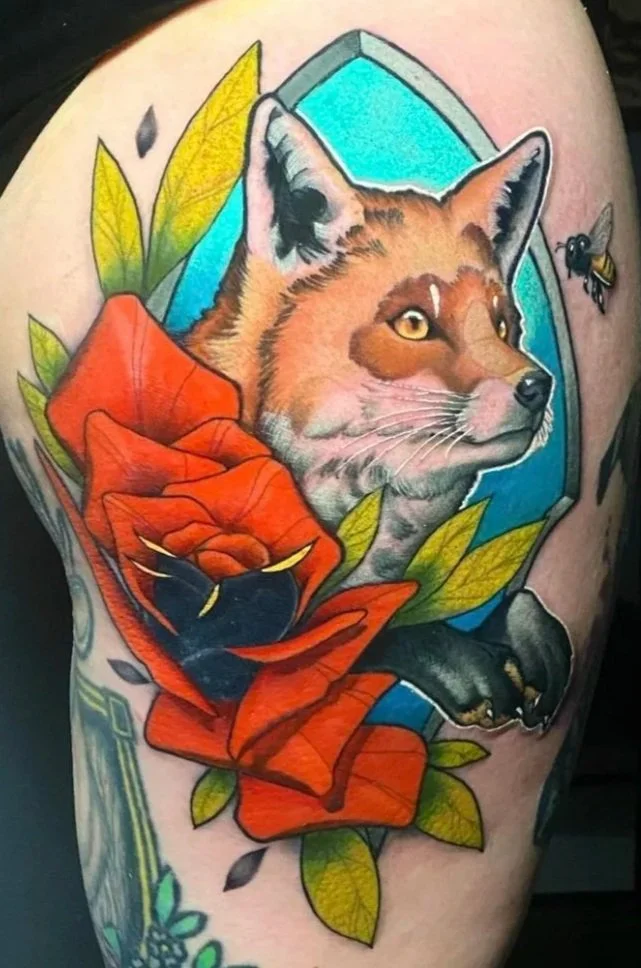
Neo-Traditional Fow & Flowers
Neo-Traditional emerged in the late 1970s through the 1990s as tattooers began stretching American Traditional's rules without breaking its bones. It's not just a more detailed version — it's an intentional balance between Traditional's classic structure and a more ornamental, illustrative approach.
Structured & Dynamic Linework:
Strong outer outlines with varied, finer inner lines that create more movement and dimension.
Expanded Color Palettes:
Often uses jewel tones, gradients, muted pastels, and hues like blue and purple that go well beyond Traditional's four-color range.
Dimensional Shading:
Layered shading and highlights that give designs more depth without becoming fully realistic.
Ornamental Styled Imagery:
Classic motifs like animals, flowers, and portraits re-imagined with decorative details, flowing shapes, or sometimes fantastical themes.
Personalized Designs:
Things like pop culture, mythology, Personal pets, and custom portraits merged with classic themes like roses, skulls, and daggers.
Main Differences:
Linework: :
Traditional uses one uniform line weight throughout the tattoo; Neo-Traditional combines bold outer outlines with thinner secondary lines for detail.
Colors:
Traditional sticks to 4-5 saturated, flat colors; Neo-Traditional uses a full-spectrum color palette with blending and gradients.
Shading:
Traditional shading is minimal and flat; Neo-Traditional shading is layered, colorful, and dimensional, creating a sense of depth and lighting.
Imagery & Subject Matter:
Traditional relies on a fixed set of classic symbolism; Neo-Traditional uses those symbols with more personalized, narrative, or fantastical designs.
Conclusion
Both styles are built to last, but they get there in different ways. American Traditional's thick black outlines and flat colors are engineered for durability, giving people a piece that’s rooted in classic influence. Neo-Traditional's more colorful, creative designs hold up just as well in the hands of a great artist. In the end, both styles share the same DNA of strong, readable imagery, but the choice comes down to whether you want a piece that's bold and iconic, or one that's more personal and uniquely yours.